Tuesday, 15 December 2009

God the Potter

One of the side-effects of William Paley's famous 'Watchmaker' analogy of creation is that it seems to have tram-lined our thinking of what it means for God to be our Creator. It conjures the picture of God bending over a bench fiddling with the various parts of each creature before releasing them into the world.

Science should cause us to change our view on this and instead see God as a potter, that is someone who both started the wheel in motion and continues to mould and shape His masterpiece.

The interesting thing is that this is exactly how the Bible portrays God:

But now, O Lord, you are our Father;
we are the clay, and you are our potter;
we are all the work of your hand.
Jeremiah 64 v 8

Sunday, 6 December 2009

The Bible & Mythology part 1


This is the god Marduk, one of the chief players in middle-eastern mythology and a character that illustrates how the Bible uses mythology to bring people to God.

In his epic struggle with Tiamat (the dragon in the background) the great beast tries to swallow Marduk only for the hero to emerge, splitting the belly of the beast in two.

A dramatic tale but what's the point? Well for me it helps us to understand why Jonah had such an impact on the people of Assyria. They had been used to hearing tales of their god emerging from the belly of a beast and so it must have been amazing to see Jonah spewed up onto the sand - a testimony to the divine origin of his message.

God's message takes people from whatever understanding they have and draws them to know Him, the true and living God.

Friday, 20 November 2009

The evolution of religion


A recent essay in the journal Science discusses the evolution of religion.

There are two strands to these kinds of studies. The first is to look for archaeological evidence for symbolic thought (like these carvings), or burial practices that indicate a belief in an afterlife. The second is more psychological, and considers what kind of thought processes are required for religious belief to exist and ask how they could have evolved (i.e. what benefits would there have been for survival and reproduction).

The article admits that the data available is really sketchy but one thing I found interesting was the reference to a study of children showing that they tend towards teleological explanations i.e. we seem built to look for an ultimate purpose.

The children were asked whether rocks are pointy because a) they are made of small bits of material or b) to prevent animals from sitting on them. The youngsters preferred the second option.

More questions than answers (what’s new!) but whether by natural selection or otherwise we’re built to seek a higher meaning to life.

Sunday, 8 November 2009

The amber flyglass


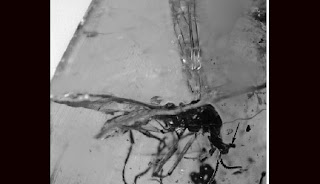
Amber is fossilised tree resin. It provides as with an intriguing alternative to the fossil record, especially where insects are concerned, because it can seemingly freeze creatures in time

In this paper a new kind of fly has been discovered. As predicted by evolutionary theory it has some similarities to modern-day flies BUT it also has striking differences. It is so different that it has been categorised as being the first example of a new family.

Around 100 million years ago Cascoplecia insolitis was buzzing around the skies, getting in the eyes of dinosaurs and the like. It shows the unique feature of having miniature eyes at the located at the end of a small protuberance (see arrow above). These are alongside the main compound eyes.

The fact that this novelty hasn’t survived indicates that it was an adaptation to specific circumstances that finally became a dead end.

(Incidentally, the name apparently means ‘old’ and ‘strange’!)

Wednesday, 21 October 2009

All across the multiverse

A recent paper by some Stanford physicists has taken a theoretical count of the possible number of universes in a multiverse. Yes I said that correctly! Imagine the whole thing starting as a immensly dense blob of everything, and then inflating like a balloon. As the surface area increases, so the theory goes, universes form in the space.

Is there any evidence for it? No, and there never will be, but the concept is a vital one for materialists who need to find an explanation for our 'just-so' universe. But just in case you are interested, the answer they came up with is 10 to the power of 10 to the power of 7!!!!!!

Well now we know!

Sunday, 11 October 2009

The hardest question

Apparently Albert Einstein once said that ‘the hardest thing to understand is why we can understand anything at all.’ I think he was wrong. The hardest thing to understand is why should there be anything to understand in the first place?

There is nothing so unfathomable as existence. Why on earth, or anywhere else for that matter, should any thing exist? It’s ironic that the one thing that is most obviously true to all of us is also the most baffling. The question of the ultimate origin is an enigma for all of us; believer, atheist or agnostic alike. For the believer, where did God come from? For the atheist, where did the universe (or multiverse) come from? For the agnostic, where did that question come from?

Yet the one thing that is absolutely certain is that we do in actual fact exist, and for as long as there has been human thought there has been an urge to try and understand it.

Thursday, 8 October 2009

Dinos of a feather


Here’s more on the evolutionary origin of birds from dinosaurs (where the archetypal fossil is Archaeopteryx!)

There’s been some controversy about the timing of the transitions – because the more transitional examples appear in younger rocks than less transitional ones – but that is most likely a quirk of the hap-hazard nature of fossilisation. Anyway this new find, Anchiornis huxleyi has helped shed some light. It’s a theropod dinosaur about the size of a cow and its around 151-161 million years old, which makes it a few million years older than Archaeopteryx. That’s the important point because it re-addresses the temporal discrepancies.

One other thing, it even has feathers on it’s feet!