Friday, 20 November 2009

The evolution of religion


A recent essay in the journal Science discusses the evolution of religion.

There are two strands to these kinds of studies. The first is to look for archaeological evidence for symbolic thought (like these carvings), or burial practices that indicate a belief in an afterlife. The second is more psychological, and considers what kind of thought processes are required for religious belief to exist and ask how they could have evolved (i.e. what benefits would there have been for survival and reproduction).

The article admits that the data available is really sketchy but one thing I found interesting was the reference to a study of children showing that they tend towards teleological explanations i.e. we seem built to look for an ultimate purpose.

The children were asked whether rocks are pointy because a) they are made of small bits of material or b) to prevent animals from sitting on them. The youngsters preferred the second option.

More questions than answers (what’s new!) but whether by natural selection or otherwise we’re built to seek a higher meaning to life.

Sunday, 8 November 2009

The amber flyglass


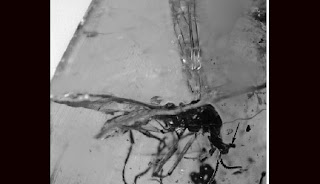
Amber is fossilised tree resin. It provides as with an intriguing alternative to the fossil record, especially where insects are concerned, because it can seemingly freeze creatures in time

In this paper a new kind of fly has been discovered. As predicted by evolutionary theory it has some similarities to modern-day flies BUT it also has striking differences. It is so different that it has been categorised as being the first example of a new family.

Around 100 million years ago Cascoplecia insolitis was buzzing around the skies, getting in the eyes of dinosaurs and the like. It shows the unique feature of having miniature eyes at the located at the end of a small protuberance (see arrow above). These are alongside the main compound eyes.

The fact that this novelty hasn’t survived indicates that it was an adaptation to specific circumstances that finally became a dead end.

(Incidentally, the name apparently means ‘old’ and ‘strange’!)

Wednesday, 21 October 2009

All across the multiverse

A recent paper by some Stanford physicists has taken a theoretical count of the possible number of universes in a multiverse. Yes I said that correctly! Imagine the whole thing starting as a immensly dense blob of everything, and then inflating like a balloon. As the surface area increases, so the theory goes, universes form in the space.

Is there any evidence for it? No, and there never will be, but the concept is a vital one for materialists who need to find an explanation for our 'just-so' universe. But just in case you are interested, the answer they came up with is 10 to the power of 10 to the power of 7!!!!!!

Well now we know!

Sunday, 11 October 2009

The hardest question

Apparently Albert Einstein once said that ‘the hardest thing to understand is why we can understand anything at all.’ I think he was wrong. The hardest thing to understand is why should there be anything to understand in the first place?

There is nothing so unfathomable as existence. Why on earth, or anywhere else for that matter, should any thing exist? It’s ironic that the one thing that is most obviously true to all of us is also the most baffling. The question of the ultimate origin is an enigma for all of us; believer, atheist or agnostic alike. For the believer, where did God come from? For the atheist, where did the universe (or multiverse) come from? For the agnostic, where did that question come from?

Yet the one thing that is absolutely certain is that we do in actual fact exist, and for as long as there has been human thought there has been an urge to try and understand it.

Thursday, 8 October 2009

Dinos of a feather


Here’s more on the evolutionary origin of birds from dinosaurs (where the archetypal fossil is Archaeopteryx!)

There’s been some controversy about the timing of the transitions – because the more transitional examples appear in younger rocks than less transitional ones – but that is most likely a quirk of the hap-hazard nature of fossilisation. Anyway this new find, Anchiornis huxleyi has helped shed some light. It’s a theropod dinosaur about the size of a cow and its around 151-161 million years old, which makes it a few million years older than Archaeopteryx. That’s the important point because it re-addresses the temporal discrepancies.

One other thing, it even has feathers on it’s feet!

Wednesday, 30 September 2009

Making Sentience

At the Dawkins evening one of the questions was about sentience and how it could have arisen. The answer given was that it must have been through natural selection but no one knows how. It would be easy to jump right in to the old ‘god of the gaps’ trap here and say ‘Aha! That’s the bit that God did!’ but that would be foolish. A) because the gap may close and B) because the implication is that God wasn’t involved in any other part.

By natural selection or some other means God has created us as sentient beings. What that means is that we are aware of ourselves. If you think about it, the most logical way for a completely natural process to go would be toward something akin to a computer i.e. something capable of completing tasks of ever-increasing complexity but without ever actually being self-aware. It’s amazing how far artificial intelligence has come, we only have to look at computer games to see that, but it is a completely blind intelligence

Yet we are not computers. We have a highly developed sense of who we are and who others are. God has created us to be aware of ourselves, and aware of Him.

Saturday, 26 September 2009

The whole tooth


All good scientific ideas have the power to make predictions. When these predictions are put to the test they can testify to the truth of the idea. Here’s an example.

Now most mammals have teeth but some, such as anteaters or baleen whales, don’t. Evolutionary theory suggests that these toothless creatures evolved from ancestors that did have teeth. So here’s the prediction. We should be able to scan the genome of the animals with no teeth and find the remnants of tooth-making genes still present. Its like digging in the sand for the broken relics of a foregone era.

As most people know teeth are covered in a hard outer shell known as enamel. One of the key genes in enamel production is called enamelin. Researchers have looked for the broken pseudogenes of enamelin in mammals without teeth and, as predicted by evolutionary theory, they’ve found them. The family tree above maps it all out.